
Cornered and Dangerous
Democracy Diary 2026.1

1. All Eyes on Texas
It’s been a minute - but Democracy Diary is back.
Today, the 2026 election season kicks off in earnest. Polls have closed in Texas, where closely watched Senate primaries on both sides of the aisle are underway — and the results will send the first real signal of what November looks like. On the Republican side, incumbent Sen. John Cornyn is fighting for a fifth term against MAGA challenger Ken Paxton and Rep. Wesley Hunt in what the Texas Tribune has called an “expensive and brutal” primary — notably without a Trump endorsement, a striking anomaly in today’s GOP. It looks like Paxton and Cornyn are headed ot a runoff.
Trump’s silence in this race is itself a tell. The president’s ideological ally, Paxton is scandal-plagued and will be a liability in the general election. So instead of leading, Trump is watching. On the Democratic side, Rep. Jasmine Crockett and state Rep. James Talarico are competing in a race that has drawn national attention and serious money — because Democrats, who haven’t won a statewide election in Texas since 1994, see a genuine opening. The bitter, divisive Republican primary, the potential midterm backlash against the Trump administration, and recent polling showing all three Republican candidates in historically competitive general election matchups have made Texas, of all places, a state worth fighting for.
What makes today significant isn’t just the candidates — it’s what the energy in Texas tells us about the broader political climate. Both parties are treating this race as a bellwether for November. And that, in turn, brings us to the subject of this post: what a president who sees the walls closing in does when he still has enormous power at his disposal.
2. The Numbers Don’t Lie — But a Cornered President Will
A year into his second term, Trump’s approval stands at 37%, down from 40% in the fall. By more than two-to-one, Americans say the administration’s actions have been worse than they expected. Among independents — the voters who decide elections — his approval has dropped 15 points over the past year to just 26%, and only 32% of Americans say Trump has had the right priorities. His net approval on the economy stands at -18.6, on trade -22.4, and on inflation -32.3 — at or near second-term lows across every major pollster.
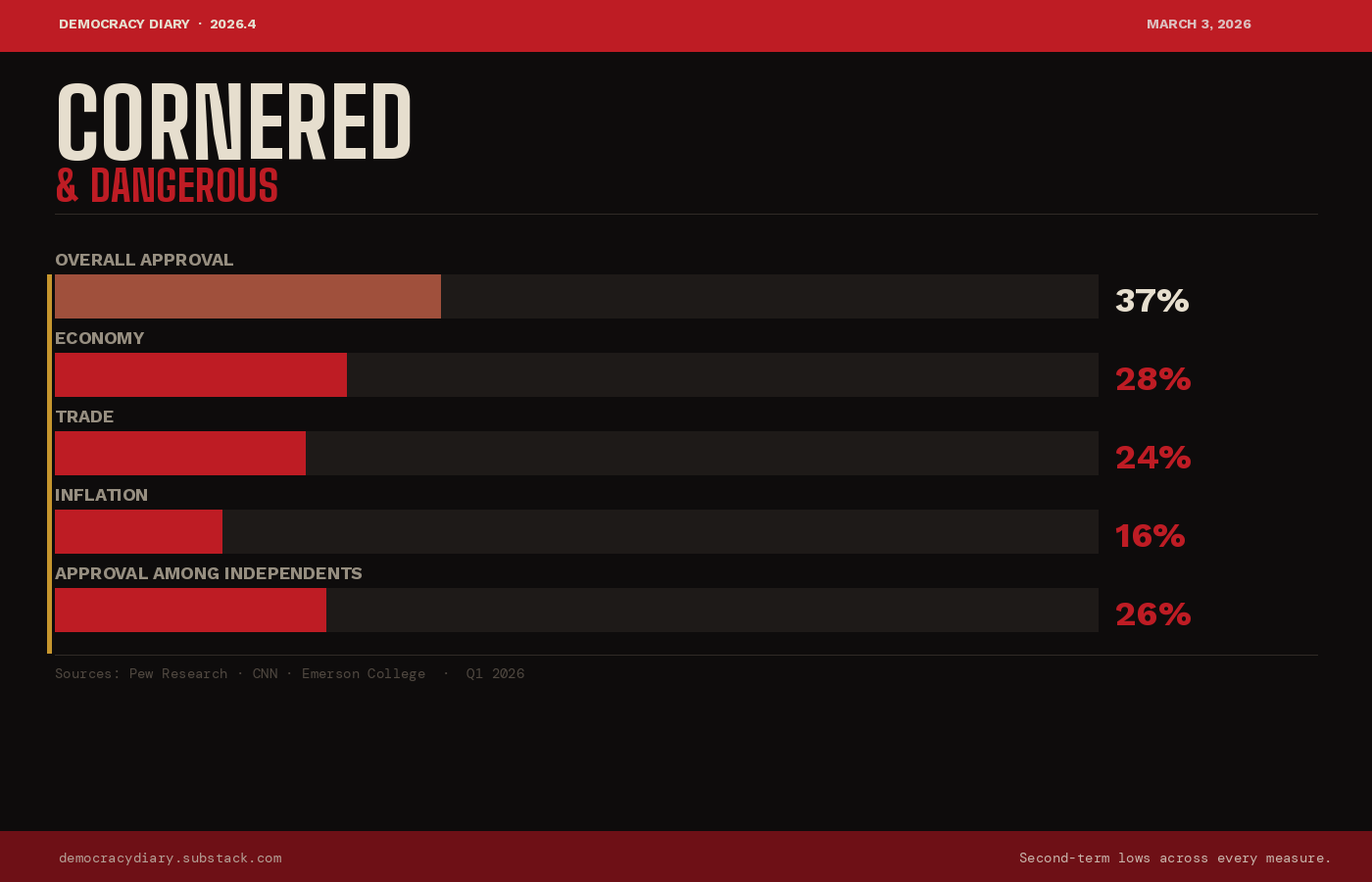
These are the numbers of a president who is losing his grip on the American electorate.
Trump’s response has not been adjustment, humility, or any gesture toward the Americans outside his base. Instead, last week’s State of the Union — the longest in American history at nearly two hours — was a masterclass in denial. Trump stood before Congress and proclaimed a “golden age of America,” touting the stock market at “all-time highs,” declaring that “inflation is plummeting” and the economy was “roaring like never before.”
He gave no indication of being chastened by his poll numbers. He announced no new policies. Instead, he taunted Democrats, basked in applause from his own side, and repeatedly denied basic reality. Brookings Institution analysts concluded that the message “failed to resonate” with a public struggling to square the president’s triumphant rhetoric with their lived experience of rising costs for food, shelter, health care, and transportation.
The State of the Union contrast was crystallized by centrist Virginia Gov. Abigail Spanberger’s Democratic response, which made exactly that argument: *we see you, we feel your pain, and the man at the podium doesn’t.* The contrast landed — because it was true.
The electoral stakes couldn’t be clearer. Sabato’s Crystal Ball gives Democrats strong odds of winning the House majority, and a real chance at the Senate if the political environment remains highly favorable. The generic ballot already favors Democrats by nearly four points. Losing even one chamber ends the legislative phase of his presidency and opens the floodgates to oversight hearings — potentially including investigations into everything from DOGE to the Epstein files to his military adventurism. For a president with Trump’s legal and political exposure, that is not an abstract setback. It is existential.
Which brings us to what cornered presidents do.
3. Preemptive Strike on the 2026 midterms
In my post, *Authoritarian Drift, I described Stephen Levitsky and Daniel Ziblatt’s first key marker of authoritarian behavior: rejecting the democratic rules of the game. I traced Trump’s history of doing exactly that — from “I’ll accept the results, if I win” in 2016, through the Big Lie of 2020, through January 6. What’s new in 2026 is that he now has the Department of Justice as his instrument — and he’s using it against the very machinery of elections, in his own party’s states.
Just last Thursday, the DOJ filed lawsuits against five more states — Utah, Oklahoma, Kentucky, West Virginia, and New Jersey — demanding comprehensive voter data, including names, addresses, birth dates, and partial Social Security numbers. The agency has now sued over two dozen states in total. Four of the five states sued this week voted for Trump in both 2020 and 2024. This is not about protecting elections. This is about building a federal database of American voter identities ahead of a midterm election that threatens his party’s hold on power.
The resistance within Republican ranks has finally become notable. West Virginia Secretary of State Kris Warner, a Republican in a deep-red state, told the federal government flatly: “The federal government is not going to get any personal information on West Virginia voters as long as Kris Warner is Secretary of State.” Kentucky Secretary of State Michael Adams was equally direct: “Kentucky law protects voters’ personal information, and I will not voluntarily commit a data breach by providing Kentuckians’ personal data to the federal bureaucracy unless a court order tells me to.” These are Republicans, in states that voted overwhelmingly for Trump, defying their own president to protect their voters. That matters — and it’s the kind of resistance from unexpected quarters that Levitsky and Ziblatt say is essential to the survival of democratic institutions.
Pair this voter data grab with Trump’s explicit State of the Union call to eliminate mail-in voting except for narrow exemptions — framed as “election integrity,” timed precisely as a vote-suppression mechanism in an election year. Together, these form a coherent strategy: shrink the electorate, reduce turnout among Democratic-leaning demographics, and build federal surveillance infrastructure over the voter rolls.
4. Wag the Dog — “Operation Epstein Fury”
The official name for the U.S.-Israeli military strikes on Iran that began last Saturday is “Operation Epic Fury.” But across social media, podcasts, and political commentary from left to right, a different name has taken hold almost immediately: *Operation Epstein Fury.* The rename is darkly funny but also a serious political indictment — because it captures something that even many Republicans are privately asking: what was the real reason for this war?
Start with the constitutional problem, because it is fundamental. Article 1 of the Constitution is unambiguous: the power to declare war belongs to Congress, not the president. The strikes on Iran were launched without congressional authorization. The Armed Services Committees were notified only after the bombs had already fallen. Rep. Thomas Massie, a Republican, declared: “I am opposed to this war. This is not ‘America First.’” Rand Paul cited his oath to the Constitution. The war powers resolutions now moving through Congress represent the most significant bipartisan constitutional challenge to executive military authority in years — and they are gaining Republican co-sponsors in ways that should unsettle the White House.
The administration’s factual case for the war is also being challenged at the highest levels. The Wall Street Journal reported this week that U.S. officials and lawmakers with access to classified information, along with experts who have spent careers analyzing public data and government reports, say the administration’s assertions about threats from Iran are incomplete, unsubstantiated, or flat-out wrong. Former Bush administration adviser Michael Singh characterized the rationale as “inconsistent and frequently erroneous” — like “building the plane while flying it.”
The administration’s internal contradictions haven’t helped: Vice President Vance insisted the goal was not regime change; Trump posted on Truth Social, asking why there wouldn’t be regime change. Secretary of State Rubio said Iran was “a week away” from the bomb; the White House simultaneously claimed prior strikes had already “obliterated” Iran’s facilities. The echoes of Iraq 2003 — the manipulated intelligence, the shifting justifications, the absence of an exit strategy — are hard to miss. The crucial difference, as one analyst noted, is that in 2003 the intelligence was manipulated to fit the lie. In 2026, the intelligence actually contradicts Trump’s claims.
And the markets have rendered their own verdict, in real time. In morning trading today, the S&P 500 dropped 2%, the Dow fell over 1,000 points at its worst, and the Nasdaq fell more than 2% — a worldwide selloff fueled by fears that the Iran war is widening and will do more sustained economic damage than initially feared. Oil prices leapt nearly 8% to $83.79 a barrel for Brent crude — up from roughly $70 less than one week ago — as Iran struck the U.S. Embassy in Saudi Arabia and widened attacks to include Gulf energy infrastructure, raising alarms about the Strait of Hormuz, through which roughly a fifth of the world’s oil passes. Higher oil prices will worsen inflation — and further erode the administration’s case that they are putting affordability front and center.
One week ago, Trump stood before Congress and declared that inflation was “plummeting” and the economy was “roaring.” Today, with the war he started still expanding, oil is surging, stocks are selling off globally, and the Fed’s hands are increasingly tied.
But there is a second distraction being served by this conflict, one that is more personal — and more revealing. During the 2024 campaign, Trump made releasing the Epstein files a rallying cry. Once back in office, he reversed course, initially dismissing calls for disclosure and labeling the files a “hoax” — before eventually signing the Epstein Transparency Act under intense base pressure.
The polling damage within Trump’s own coalition is real. A University of Massachusetts poll found that 47% of Trump’s own 2024 voters disapprove of his handling of the Epstein controversy — and among that group, 28% now disapprove of Trump as president overall. The Washington Post concluded that Epstein is the one issue that consistently splits Trump from his base.
Joe Rogan, who endorsed Trump in 2024, called the files “a line in the sand.” As early as November, Time magazine reported signs that the MAGA movement may be “outgrowing the man who built it.” Among MAGA influencers, the phrase now circulating is that the Epstein betrayal is Trump’s first genuine red line with his base — the thing he promised that, if he doesn’t deliver, they can’t rationalize away. The Iran escalation arrived just as the latest wave of Epstein revelations was dominating headlines, including reporting on missing pages with allegations involving Trump directly.
5. The Stakes Are High — And the Resistance Is Growing
The picture drawn in this post is alarming. But the resistance is real, it is growing, and it is coming from places that matter.
Republican secretaries of state in West Virginia and Kentucky are standing between your voter data and the federal government. Republican members of Congress — Massie, Paul, and a growing bipartisan coalition — are demanding constitutional accountability on war powers.
Even within the MAGA base, cracks are showing on Epstein in ways that no political consultant would have predicted a year ago. None of this is sufficient on its own. But it is the architecture of accountability that democratic societies require — and it is being built, one act of resistance at a time.
The midterms are the constitutional remedy. House oversight, Senate subpoena power, the ability to defund unauthorized military operations, independent investigations — all of it flows from November. The Texas primaries are the first milestone.
A president who is cornered and knows it is a more dangerous president. The voter data lawsuits, the unauthorized war, the Epstein stonewalling, the State of the Union defiance — these are not isolated actions. They are moves made by a man who understands that the clock is running and the stakes are total.
The answer to that is not despair, nor is it exhaustion. It is the discipline shown in Minneapolis this winter, where tens of thousands of people turned out in subzero temperatures night after night after ICE agents fatally shot two American citizens — and kept showing up until the federal government blinked and ended Operation Metro Surge. Mayor Jacob Frey's words when it was over say it plainly: "They thought they could break us, but a love for our neighbors and a resolve to endure can outlast an occupation." Show up, document, challenge, and refuse to normalize what is not normal. The stakes are high. The resistance is growing. Both things are true at the same time.
Stay awake. Stay in the fight. More soon.
Sources and Further Reading
Polling / Electoral landscape
- Pew Research: Confidence in Trump Dips in 2026
- CNN Poll: Trump’s approval among independents hits a new low | Feb 23, 2026
- Emerson College: February 2026 National Poll | Feb 26, 2026
- Sabato’s Crystal Ball: Generic Ballot Model for 2026
State of the Union
- NBC News: Three Takeaways from Trump’s State of the Union | Feb 25, 2026
- Brookings: Trump Relies on Showmanship and Base Appeal | | Feb 28, 2026
Voter data
- Fox4News: Election integrity : Justice Department Sues More States| Feb 27, 2026
Iran / Markets
- WSJ: Trump’s Case for War With Iran Faces Growing Scrutiny | Mar 2, 2026
- NPR: Iran strikes launched without congressional approval | Feb 28, 2026
- Al Jazeera: How Trump’s Iran script echoes the Iraq playbook | Feb 26, 2026
- WBUR: Dow drops 1,000 as stocks sell off amid war worries | Mar 3, 2026
- The Nightly: Operation Epic Fury or Operation Epstein Distraction? | Mar 1, 2026
Epstein
- PBS: MAGA Faithful’s Anger Over Trump and Epstein | Jul 2025
- UMass: The Conversation: Trump’s Epstein Problem | Aug 2025
- Time: Signs of Trump Losing Grip on MAGA Movement | Nov 2025
Minneapolis / Operation Metro Surge
- NPR: Trump border czar announces Minnesota immigration surge is ending | Feb 12, 2026
Texas primaries
- Washington Post: Texas Senate Primary Results | Mar 3, 2026
- NPR: What to expect in the Texas midterm primaries | Mar 2, 2026