
Skyfalling
Democracy Diary 2026.3

Skyfall is where we start
A thousand miles and poles apart
Where worlds collide and days are dark
-Skyfall, Adele and Paul Epworth
I love a Bond movie. Perhaps especially a Daniel Craig Bond Movie.1
Skyfall (2012) is a classic with a deep undertow of nostalgia. It is a film about the end of an era. An institution — MI6, British intelligence, the idea of the West as a protector — comes apart. The villain is not a foreign power. He is a former asset who returns to prove that the thing everyone trusted to keep them safe had rotted at the core.
The institution produced the means of its own destruction.
1. Skyfall
One short year ago, the United States was indisputably the most powerful nation on earth — not just militarily, but also the country other countries chose to stand with.
What has happened in fourteen months is not just a foreign policy failure. It is category collapse. The post-World War II architecture of alliances, credibility, and shared interests that American presidents and their counterparts in the West spent 80 years building has been treated as disposable by the U.S. president, a man for whom all relationships are transactional. With U.S. and Israeli forces now locked in a widening war with Iran, the full cost of that calculation is visible to everyone — including to the countries that had been quietly, in some cases obsequiously, absorbing insults and hoping for the best.2
2. Making enemies of friends
The disintegration did not begin with Iran.3 It began on the first day of this second term, and — one affront at a time — the transatlantic alliance began to look less like a partnership and more like a hostage situation.
Early in his presidency, Trump took to calling Canada — the country that shares the longest undefended border in the world with the United States, whose soldiers died in Afghanistan alongside ours, whose economy is interwoven with the U.S. — the “51st state,” and referred to both of its prime ministers as “governor.” The statement was not just trolling. It was a policy position and a threat.
In January, Trump threatened eight NATO allies — Denmark, Norway, Sweden, France, Germany, the United Kingdom, the Netherlands, and Finland — with tariffs of up to 25 percent. Their offense: sending military personnel to Greenland, which Trump had decided he would take “one way or another.” He asked the chairman of the Joint Chiefs to present options for a military seizure of Danish territory. He texted the Norwegian prime minister that he no longer felt an “obligation to think purely of Peace” because he had not won the Nobel Prize. Trump also asserted he’d done more for NATO than any president - and said it “should do something for the United States” in return.
At Davos this year, Canadian Prime Minister Mark Carney said aloud what many other leaders had to be thinking. “Today I will talk about a rupture in the world order,” said Carney, “Great powers now use trade, finance, supply chains, and tariffs as instruments of coercion rather than cooperation, “ and “Canada was amongst the first to hear the wake-up call.” Canada has since begun building new strategic partnerships with China, Qatar, and the EU.
3. Paying the price
Trump has spent the year dismantling something older and more fragile than domestic institutions — the presumption that America can be trusted. In 2016, U.S. global favorability stood at 65 percent. By the end of the first Trump administration, it had collapsed to 27 percent. Biden brought it back to roughly 62 percent. And then Trump was reelected.
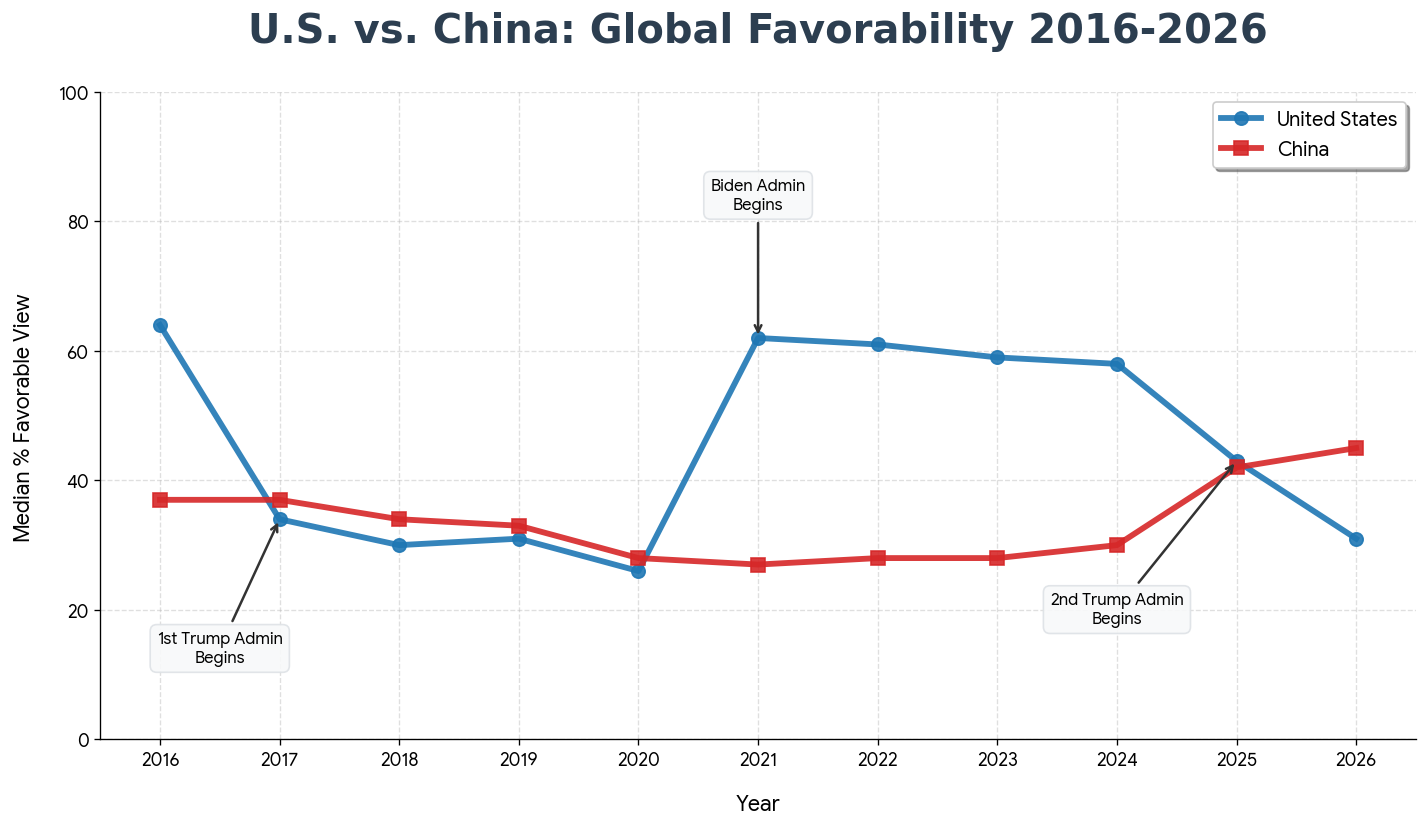
By early 2026, China had reached rough parity with the U.S.— a development that would have been unthinkable a decade ago. And now China has pulled ahead. A Morning Consult poll documented China’s net favorability climbing from negative in early 2024 to positive by mid-2025. The U.S. went the other direction.
Soft power is an economic engine. NYU professor, podcaster and author Scott Galloway (“Prof G”) has argued that the United States status as the “operating system” of the global economy — as the country everyone trusted, whose dollar everyone held, gave us a “premium.” It is why the U.S. dollar serves as the world’s reserve currency, and why the U.S. borrows more cheaply than any other nation. Extracting value from that position does not require military force. It does demand maintaining the trust that underpins the American premium.
The American brand, says Galloway, has now become “chaos, corruption, and coercion.” You cannot run a premium on that. The U.S. favorability slump means the world is actively seeking an alternative. Meanwhile, Russia — along with China one of the U.S.’s six official foreign adversaries — benefits from oil prices created by the Iran war and the lifting of American sanctions.
4. Strait talk
On February 28, 2026, the United States and Israel launched coordinated strikes on Iranian military facilities. Within days, the consequences of having spent a year torching every alliance became a live emergency — in a way the Trump administration appears not to have anticipated.4
In retaliation, Iran moved to disrupt traffic in the Strait of Hormuz, the chokepoint through which roughly 20 percent of the world’s oil moves, a move that was not a surprise to experts, including several of Trump’s advisors.5 Energy analysts have flagged this scenario for decades. And yet the Trump administration did not fully replenish the Strategic Petroleum Reserve before the war began. They had, according to CNN reporting, sidelined interagency warnings over the war’s likely economic fallout in favor of a tight circle of advisers not inclined to complicate the plan - or anger the president - with unwelcome hurdles.
Faced with a crisis, Trump first tried to bend reality to his will. He called — unsuccessfully — for tankers to ignore the extreme risk, telling Fox News‘ Brian Kilmeade on March 11, that “these ships should go through the Strait of Hormuz and show some guts, there’s nothing to be afraid of.” He demanded that Iran back off, and they have responded with defiance. Saturday, he gave the Iranians a 48-hour ultimatum to “FULLY OPEN, WITHOUT THREAT, the Strait of Hormuz” or the U.S. would begin hitting Iranian power plants. As of this morning, he has backed down from that ultimatum, citing productive talks.
Trump insisted that Britain, France, Germany, Japan, South Korea send warships to reopen the strait. They refused. Germany’s defense minister was precise: “This is not our war. We did not start it.” British Prime Minister Keir Starmer was clear that Hormuz was not and would never be a NATO mission. Spain denied the United States use of military bases at Rota and Morón, calling the strikes “a big error.” France called them a violation of international law. Poland’s foreign minister said publicly he had seen no “direct threat” to Europe, the United States, or Israel from Iran before the strikes began. Trump called them cowards.
Anne Applebaum, writing in The Atlantic, argued the European refusal is not cowardice, “it’s a calculation.” World leaders, she wrote, “remember that for 14 months, the American president has tariffed them, mocked their security concerns, and repeatedly insulted them.” They understand that any contribution they make will count for nothing, that Trump will not remember it happened. He does not connect actions he takes on one day to consequences that arrive weeks later. He does not take responsibility when they go wrong. The allies do. They remember. And they have concluded there is no point in sending ships to reopen a strait for a president who will threaten them with tariffs the following month.”
Our allies, if we can still call them that, are done. Meanwhile, the U.S. has a war of choice on its hands, with no obvious way out, continuing loss of life, and a price tag of billions of dollars per week.
5. Switzerland
Switzerland — not a member of NATO and has not fought in a foreign war in over two centuries — announced Friday that it will not issue new arms export licenses to the United States for the duration of the Iran conflict. “The export of war materiel to countries involved in the international armed conflict with Iran cannot be authorised for the duration of the conflict,” the government stated. The United States was Switzerland’s second-largest arms customer last year, accounting for roughly $119 million in sales.
Under law, the War Materiel Act, Switzerland is legally required to halt military exports to nations involved in international armed conflicts. Switzerland has applied the same prohibition with ruthless consistency to Israel and Iran and even to Ukraine in its war with Russia. The Swiss also rejected at least two U.S. military flyover requests for Iran-related operations. The Swiss defense minister called the U.S.-Israeli strikes contrary to international law.
A year ago, it would have been hard to imagine. The United States helped write the rules — the guarantor of the post-war stability. Now we find ourselves on the wrong side of the line when the rules-based order is enforced.
6. Skyfall(out)
The president’s theory of power — that strength means dominating allies and accommodating adversaries — produces exactly the opposite of security. It drives isolation. The Iran war did not create that isolation — it simply made it impossible to ignore.
Even if Trump left office tomorrow, the damage would remain. In the span of a single year, the United States has trained the world to expect us to act unilaterally, transactionally, and without regard for anyone else’s security or prosperity. That is not a lesson easily unlearned. Countries have begun building around us — new partnerships, new alliances, new habits of saying no.
The trust that took eighty years to accumulate will not be restored on a timetable anyone can predict. Who knows if it will be regained at all?
Sources
Reporting
Layla Maghribi, Al Jazeera: “Switzerland halts US arms exports amid Iran war, citing neutrality” (March 20, 2026)
Liz Sly and Michael Birnbaum, Washington Post: “European leaders rebuff Trump’s call to open Strait of Hormuz” (March 17, 2026)
Zeeshan Aleem, MSNBC/Now: “Why Trump can’t get allies to help him reopen the Strait of Hormuz” (March 16, 2026)
PBS NewsHour: “Trump’s failed strong-arming of allies on Iran shows that pressure is losing its effect” (March 17, 2026)
Kylie Atwood and Jennifer Hansler, CNN: “Trump lashes out after he fails to convince European allies to help in war with Iran” (March 17, 2026)
Matthias Matthijs, Council on Foreign Relations: “Europe’s Disjointed Response to the War With Iran” (March 6, 2026)
Atlantic Council: “Experts react: How the world is responding to the US-Israeli war with Iran” (March 3, 2026)
Veronica Stracqualursi and Clare Foran, CNN: “Trump threatens new tariffs on European allies over Greenland” (January 18, 2026)
Deepa Shivaram, NPR: “Trump backs off tariff threats and hails ‘framework of a future deal’ on Greenland” (January 21, 2026)
Wikipedia: “Reactions to the 2026 Iran war”; “Greenland crisis”
Analysis & Opinion
Anne Applebaum, The Atlantic: “Everyone but Trump Understands What He’s Done” (March 17, 2026)
Scott Galloway, No Mercy / No Malice: “The U.S. was ‘the operating system of the world’” (January 2026); and The Prof G Pod
Data
Chart: U.S. vs. China: Global Favorability 2016–2026. Sources: Pew Research Center; Morning Consult
Let the arguments about which Bond - and which songs from the franchise - are the best -commence. And queue the speculation as to who will be the next OO7.
We’ve come full circle since February 27, 2025, when British Prime Minister Keir Starmer was all charm and flattery in the Oval Office, presenting the president with a formal invitation for an “unprecedented” state visit. Last week, Irish Taoiseach Micheál Martin, during a traditional St. Patrick’s Day visit with the president, had to step in to defend Starmer and the U.S./UK relationship after Trump called the UK Prime Minister, “no Winston Churchill.”
To be clear: the Iranian regime is terrible. Since taking power in 1979, they have engaged in mass executions, torture and the persecution of women and minorities at home. Abroad, they have engaged in global assassinations, funded Hezbollah, Hamas and the Houthis and been designated the world's most prominent state sponsor of terrorism every year since 1984 by the U.S. State Department.
And let’s not forget the human cost of the war so far. There have been thousands of deaths - primarily in Iran and Lebanon, but dozens of others throughout the Middle East. Millions have been displaced. Thirteen U.S. Service members have lost their lives, and over 200 have been injured.
The Wall Street Journal reported that General Dan Caine, Chairman of the Joint Chiefs of Staff, warned the president that “Iran would deploy mines, drones and missiles to close the world’s most vital shipping lane, according to people with knowledge of the discussions.”